Friday, 13 December 2013

Harmonisation 0.0 – Sustainability


A balance must be maintained between social, economic and
environmental requirements for sustainability to be reached.
Taken from: http://www.keepoklahomabeautiful.com/sustainability


Before I delve further into the topic of harmonisation, there are some fundamental concepts that need to be defined; sustainability is the first of these. Sustainability is a word that comes up in conversation quite a lot these days but often is not entirely understood. When I asked my geology friend; “How would you define sustainability?” during our conversation on energy, he replied; “It is when you can take resources that can be replaced”. This is indeed sustainable, but sustainability has a much broader definition.

Sustainability itself stems from the term sustainable development which, in 1992, was defined as “Development that meets the needs of the present without compromising the ability of future generations to meet their own needs” in the Bruntland Reportfor the World Commission on Environment and Development. The idea of sustainability has been refined since then and is the only logical answer for future change.

There is no universally agreed definition of sustainability, but here are a few that I found online:

·      “Sustainability is based on a simple principle: Everything that we need for our survival and well-being depends, either directly or indirectly, on our natural environment.  Sustainability creates and maintains the conditions under which humans and nature can exist in productive harmony, that permit fulfilling the social, economic and other requirements of present and future generations.”
·      “Sustainability is the capacity to endure. In ecology the word describes how biological systems remain diverse and productive over time. Long-lived and healthy wetlands and forests are examples of sustainable biological systems. For humans, sustainability is the potential for long-term maintenance of wellbeing, which has ecological, economic, political and cultural dimensions. Sustainability requires the reconciliation of environmental, social equity and economic demands - also referred to as the "three pillars" of sustainability or the 3 Es.”
·      “Sustainability is a state of dynamic equilibrium achieved by taking responsibility for balancing long term economic, environmental and social health --for ourselves, our communities, and our world.”
From these definitions and others I have read, I would now answer my own question as so;
“Sustainability is the harmony of humans and nature, where our social, economic and environmental needs are met without incurring negative impact on our world and therefore paving a positive path for future generations.”

With this in mind a better evaluation of attempts to become sustainable and therefore harmonised with nature can be attained.

Saturday, 7 December 2013

Harmonisation 1.0 - Diet

Now that I have tied up some of my previous topics, I wish to move on to the main idea of my blog – harmonisation. In each section I will take a different part of the human lifestyle and look into how it can be changed to become more sustainable. I will begin by looking at diet. Currently agriculture is the second biggest emitter of greenhouses gases after the energy industry. The 2010 FAO symposium on sustainable diets and biodiversity highlights many of the current problems with our dietary system; these include uneven resource distribution (starving vs overweight people), high energy use, inputs of chemicals into the natural system, deforestation, biodiversity loss, water shortage, and cultural loss.
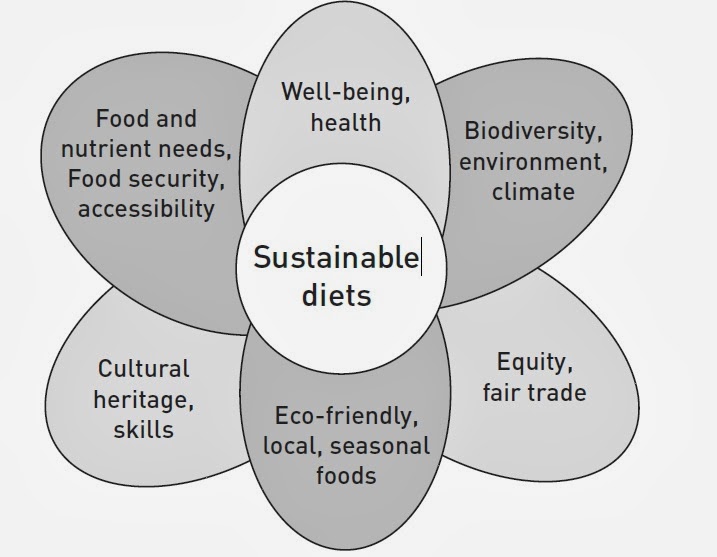
The picture below outlines the main components of a sustainable diet – these are what need to be achieved by our agricultural systems. We currently live in a society where industrial agriculture takes centre stage for food production, but this is a problem. Because this intense farming is not in harmony with its environment, it is damaging and unsustainable. A new approach to farming must be taken if we are to provide for the increasing population without the destruction of Earth. Fortunately, organic farms are already on the increase, but will this be enough?


Six major components of a sustainable diets - all of these need to be conisdered in our future agricultural systems. Taken from: http://www.fao.org/docrep/016/i3004e/i3004e.pdf

A 2013 paper by Vinceti et al. looks at the contribution of forests to a sustainable diet. Rather than removing our precious forests to replace them with fields of crops, they could be used to provide food for the communities that live nearby. Forests are full of nutrient rich, affordable and ultimately sustainable foods such as mushrooms, animals and shrubs, which if used correctly will cause little or no damage to the environment. These wild foods also promote culture and tourism in some ways. It is exciting how many varieties of wild fruit that can only be found in tropical forests – some of which could only be experienced by travelling to the area of supply. This is only one example of how humans and nature can harmonise while providing food for our population.

Here is a TED talk by Jonathan Foley who has some ideas about agriculture which I share:


Wednesday, 27 November 2013

Carbon Major: Major Problem


Taken from Heede, 2013

Here is a graph. Like many carbon emission graphs, it shows the almost exponential increase in anthropogenic emissions since the industrial revolution, but here we will focus on the big red line. This shows the emissions of just 90 entities, known as the carbon majors. That is 90 companies that have emitted two thirds of all carbon emissions since 1850 – a whopping 914 billion tonnes of CO2-equivalent.

In a paper by Richard Heede published last month, he analyses who should be responsible for our historic carbon emissions. Logically those who have thrived from the destruction of our planet should be the first to step up and save it.

In 1992 the United Nations Framework Convention on Climate Change (UNFCCC) was initiated, placing the responsibility of our historic emissions in the hands of a group of nations known collectively as Annex 1. These consist of the wealthiest countries around the world, who have become so from the energy provided from fossil fuels. Richard puts forward a new approach in his analysis. By tracking down the emissions to their primary source it would appear that not all of the carbon majors are within the Annex 1 nations.

An updated framework targeting oil, natural gas and coal companies is in order; all that money they have earned from destroying the Earth should now be used to help mitigate the damage they have caused. These entities have the technology and funding to make the step to a more sustainable future.

I recently attended a careers evening with an oil company, whose name I will not mention. Sadly they appeared to have no intention of making any change, claiming that oil was needed now more than ever.


I will leave you on a lighter note; here is a company really making a difference to how they are running things!


Friday, 22 November 2013

Those Bloomin' Phytoplankton - Ocean Iron Fertilisation

In my first post I spoke about global CO2 levels reaching 400ppm, an all time high since before the evolution of Homosapiens. One comment asked if ocean iron fertilisation (OIF) could be an answer to reducing the global CO2 levels, so I decided to look into it. This post aims to assess the suitability of OIF as a combat against anthropogenic carbon emissions.

Taken from: www.wikipedia.com

The biological pump (BP) is an important part of the global carbon cycle; the ocean's phytoplankton reduce carbon dioxide levels via photosynthesis. However, on a global scale, net carbon dioxide flux between the ocean and the atmosphere is zero. Sometimes the BP acts as a sink, removing CO2 in the form of biogenic carbon that is buried in the sediment, but often the sequestered carbon never makes it to the ocean floor and is instead recycled back into the ocean-air system.

Locally there is variation in the net flux of CO2 by the BP. In a 2008 paper by Jin et al. they define an area that removes CO2 from the atmosphere as efficient while an area that that loses CO2 to the atmosphere is inefficient. The experiments they carried out (along with many other experiments) prove that the addition of iron to these inefficient sites would increase the downward flux of CO2, effectively reducing the impact of anthropogenic emissions. That said, is this alteration of an earth system such a good idea?

What is yet to be understood is what effect increased phytoplankton will have on food web dynamics – it is likely that an increase in phytoplankton population will put strain on other microorganisms. It could also link to nutrient deficiency and increased ocean acidification, however more research does need to be carried out.

Kelley's Island Algal Bloom
Do we want this to be a common sight in our oceans? Taken from: http://www.ohiolakefrontgroup.com

The fact that iron is often the limiting factor of BP's CO2 sequestering properties is widely accepted in the scientific community, but to what extent fertilisation can increase its potential sink is still uncertain. Jin et al. suggest that the effect of iron fertilisation is in fact small, which may make it unsuitable when taking into account the negative implications of OIF.

In a Kiel policy brief by Christine Bertram, she concludes that it is unlikely that iron fertilisation will be used due to the costs and amount of surveillance involved. However there is some concern that big carbon emitting companies will use iron fertilisation in an unregulated fashion to produce a carbon offset. Bertram believes a policy should be set in place to avoid this, as it could have drastic results if left unresolved.

I believe that a better insight into the negative impact of iron fertilisation should be achieved before this is made available as a mode of carbon offset, if made available at all. As one might say, prevention is better than cure and this only sets out to cure.

Sunday, 17 November 2013

A Simple Model for The Problem Ahead


Wonderingmind42 is a video blogger on youtube. In this video he sets out the four main futures for humanity and concludes that we must take action, regardless of the situation.